well, maybe :)
My blog has moved!
Check it Out Here!
Thursday, August 15, 2013
Sunday, August 11, 2013
Word of the Week!
Again, in honor of doing "Fiddler on the Roof" at our church, i'm choosing a Russian word to balance out the blog a little. And to give you something other than my Hebrew etymology. Also, there are 5 daughters, and the word below can incorporate the metaphor described below.
The word is matryoshka, or

The word is matryoshka, or
Матрёшка
This word is the name for the Russian nesting dolls. For an interesting read on the dolls and their influence on Russian culture, see here!
The word literally means "little matron", coming from the word in its diminutive form for a formal first name. (see wiki article.) I always thought it meant to "little mother." But in doing some research I discovered that the term matroyshka is also used as a metaphor description. Similar to the onion affect, it means one object within a smaller object concept. For example, in "Fiddler", the 5 daughters each reveal a different layer in the incorporation of the changing times. Almost as how the dolls reveal another new doll inside.
Hope this gives everyone a new perspective on an old tradition! TRADITION!
Saturday, August 10, 2013
Past, present, and future
Have you ever heard someone say "Today's a gift, that's why we call it the present." I'm sure we all have. The phrase, almost overused and definitively a cliche is meant to give inspiration and invoke gratitude in the listener. I would like to argue that this phrase can mean so much more and yet doesn't encompass the greater meaning of Christian gratitude as some people expect.
First, let's look at the phrase. Yes-I will not argue that today is a gift from God. That is biblical supported both positively and negatively, through many Psalms and Matthew 6 where Jesus tells us to worry about the day at hand, not tomorrow. However, yesterday was a gift too, and tomorrow will be a gift. And your family is a gift. Even your own breathe of life is a gift from God. Though I enjoy the fact the phrase encourages gratitude, the thankfulness should be expanded past the "present."
Second, present is a manmade term, not something of God. Time is manmade. Many items defined in the Bible from God incorporate more than a present sense of reality. They include all senses of time. And they include all aspects of your livelihood. For example...when discussing resurrection. Christians state in the Apostle's Creed we believe in the "Resurrection of the Body." But how many people ACTUALLY believe that. I know I do... and I am so excited about God for that. But N.T. Wright in his book Surprises By Hope talks about the Biblical interpretation of a bodily resurrection and this is far beyond the contemporary concepts of what heaven & hell are.
So next time you think of the present as a gift, remember there are far many more things to be thankful for of a God who is without end and undefinable by human standards. God bless be the Creator and Ruler of All!

Tuesday, August 6, 2013
The Return of the Kosher Pig: The Divine Messiah in Jewish Thought by Rabbi Itzhak Shapira
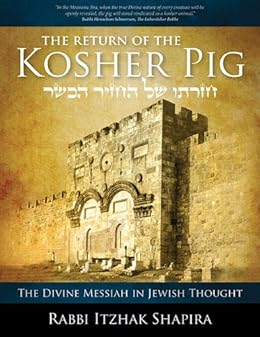
pages: 335, with glossary, recommendations for related books and even a couple sleeves for notes.
Book on Amazon
Warning: This book is not for the everyday average reader, let alone the average Christian (if there is such a thing.) Though I argue that this is an excellent book, filled with a plethora of information and details beyond your wildest dreams-- a lot of the information goes well above a reader's head , dealing with traditional rabbinical views, jewish thought & jewish theology that are well beyond the scoop of a "normal read."
But despite that warning--this book is very intriguing. It is written by a messianic rabbi *see author above* who discusses how he grew up in Jewish community in Israel and wants to point from a Jewish prescriptive proof that Jesus was the Messiah found within the Scriptures. He uses traditional jewish defense and refers to several rabbinical texts to provide proof of his argument about Yeshua (Jesus--he specifically uses this term as he wants to distinguish in this book the Jewish aspects.)
Again I want to emphasize there is A LOT of information in this book. Rabbi Shapira provides several examples of how rabbis interpret certain Messianic scripture, record discussions about the authority, teachings and definition of how Jesus is the claimed Messiah of the Scriptures. He even refers to rabbis that state truths but then sacrifice their teachings for human agreements to dispute Messianic claims.
There are some claims that go a little beyond standardized thinking... discussions about jewish numerology (there is another term for this but I figured I would simplify it) and how certain messianic affiliated verses add up to the same figured and (as the author argues) gives more support to Jesus as the Messiah. Thought I do not argue against Jesus as Messiah... I do not think you need every little ounce of defense, including the mystical aspects of belief. Interesting...but not necessary.
Otherwise, this is an excellent, well documented and informed book about the Messiah in Jewish thought. Thought it was not written for most believers, I do think any believer could benefit from a reading of this book.
Monday, August 5, 2013
The Atoms of Language: The mind's Hidden Rules of Grammar by Mark Baker
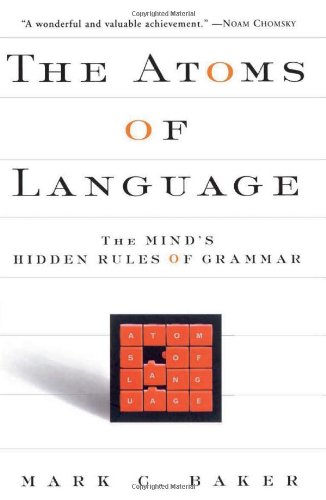
Kindle Edition: 276
Amazon Link: The Atoms of Language
For those of you like me who are interested in how language works and functions, this is an excellent book to get started with. The book makes the analogy that just as there is a periodic table for the elements in chemistry, there is a "table" of sorts that linguists are putting together that can categorize and structure languages of the world. Baker discusses how linguistics are forming "parameters" that separate languages from others (usually associated with the subject location, verb, placement of words and verb phrases.) Bakers implies that these parameters help categorize and structure language as a whole more efficiently than country of origin or cultural difference associated with each language.
Mark Baker does an wonderful job of making linguistics readable for the average person--and yet not sacrificing terms, definitions and examples from the field of linguistics. Examples include associates between Japanese, English, French, a native-american language from the Iroquois, Mohawk, and discusses other unique languages that one may not readily think of when discussing tongues of the world.
A basic knowledge of English grammar and syntax would be necessary for understanding this book, along with perhaps knowledge of another language other than your own since some topics make sense with some bi-lingual knowledge base.
For those of you like me who are interested in how language works and functions, this is an excellent book to get started with. The book makes the analogy that just as there is a periodic table for the elements in chemistry, there is a "table" of sorts that linguists are putting together that can categorize and structure languages of the world. Baker discusses how linguistics are forming "parameters" that separate languages from others (usually associated with the subject location, verb, placement of words and verb phrases.) Bakers implies that these parameters help categorize and structure language as a whole more efficiently than country of origin or cultural difference associated with each language.
Mark Baker does an wonderful job of making linguistics readable for the average person--and yet not sacrificing terms, definitions and examples from the field of linguistics. Examples include associates between Japanese, English, French, a native-american language from the Iroquois, Mohawk, and discusses other unique languages that one may not readily think of when discussing tongues of the world.
A basic knowledge of English grammar and syntax would be necessary for understanding this book, along with perhaps knowledge of another language other than your own since some topics make sense with some bi-lingual knowledge base.
Sunday, August 4, 2013
... TO LIFE!....
Word of the Week, episode 2 :)
This weekend and next weekend are the performances of my church's fine arts ministry program. This year we are doing Fiddler on the Roof, a traditional show about, well, tradition amongst Hasidic Russian Jews. It is actually based on a true story/book and deals with several issues for the jewish population in Russia during the early 20th century (1900s). Fun show--deep philosophically speaking but still fun.
One of the songs in the show is called L'chai-im!, or To Life. Since this is a Hebrew word... I thought I would be elaborate on its meaning & significance.
I was able to locate this word in the Biblical context, in Isaiah 4. In this case it is used in a different context -- but it has the same meaning "to life." It comes from the Hebrew word for "life." The same word is the root for the verb, for living things. (see pg 310-313 of the Brown Driver Briggs Lexicon) I want to saw that this words is like the living source of everything. It interconnects all of creation. The term is used in the Bible for people's livelihood, for life in general, for reference to sustenance and for maintaining existence.
So if you ever get to see "Fiddler on the Roof," when the men start singing in the bar about life... keep in mind that it doesn't just incorporate the amber colored liquid in their cups :)
This weekend and next weekend are the performances of my church's fine arts ministry program. This year we are doing Fiddler on the Roof, a traditional show about, well, tradition amongst Hasidic Russian Jews. It is actually based on a true story/book and deals with several issues for the jewish population in Russia during the early 20th century (1900s). Fun show--deep philosophically speaking but still fun.
One of the songs in the show is called L'chai-im!, or To Life. Since this is a Hebrew word... I thought I would be elaborate on its meaning & significance.
My™I¥yAjAl
So if you ever get to see "Fiddler on the Roof," when the men start singing in the bar about life... keep in mind that it doesn't just incorporate the amber colored liquid in their cups :)
Subscribe to:
Posts (Atom)